


Hard floors are a permanent decision. Once you commit to concrete or a polished hard surface, you’re in. The look, the maintenance, the way sound moves through your home. In a single-story property, that last part barely registers. In a two-story home in Plano, a townhome in Fort Worth, or a condo in Uptown Dallas, it registers loudly.
Impact noise is what happens when a footstep, a dropped item, or a pushed chair puts energy directly into your floor structure. That energy travels through the slab and into the room below. A lot of DFW homeowners discover this for the first time after a renovation is already done.
The Duraamen Soundproof Flooring System is designed to prevent exactly that. Acoustic control goes in at the base of the floor, before the finish is ever applied. You get the hard surface you want and the quiet you didn’t know you needed to plan for.
Why Hard Floors Carry Sound the Way They Do
Concrete is dense and rigid. That’s what makes it durable and long-lasting. It’s also what makes it one of the most efficient sound conductors you can put in a home.
Impact noise is different from airborne noise. Airborne sound (voices, a TV, music) travels through the air and loses energy along the way. Impact noise doesn’t work like that. A footstep puts energy directly into the structure of your floor and sends it where the slab goes: straight down into the room below.
This matters most in situations like these:
- Two-story homes in DFW suburbs where an upstairs living area or bedroom sits above a room you spend time in
- Condos and townhomes in Dallas, Fort Worth, Plano, Allen, or anywhere the floor between units separates you from a neighbor
- Renovation projects adding new hard flooring over existing concrete, which makes impact transmission worse than it was before
What Dallas-Fort Worth Homeowners Should Know About Sound Ratings
If you own a condo or live in a community with an HOA, this part matters for you specifically. Building codes in Texas require a minimum IIC rating of 50 (Impact Isolation Class) between floor assemblies in multi-family buildings. Many HOA communities in the Dallas-Fort Worth area, especially in master-planned developments and luxury high-rises, require even more.
If you’re planning a flooring renovation that involves hard surfaces, it’s worth knowing what your HOA requires before you start. Installing without meeting those ratings can trigger complaints, require you to redo the work, or create issues if you ever sell.
If you’re a contractor or architect working on multi-family projects in DFW, you already know this part. The point is the same: impact isolation needs to be part of the spec before the finish floor goes in.
The Duraamen Solution: Sound Control Built Into the System
Most soundproofing approaches work fine but end with a conventional finish. A mat goes down, concrete goes over it, then tile, LVP, or hardwood goes on top. The noise problem is addressed. But the floor looks like any other floor.
This system ends with a Skraffino microtopping. That’s a seamless, polished concrete surface with no grout lines, no tile edges, and no visible seams. It can be colored with Colorfast integral pigments, dyes, or stains, so the final look is completely customizable. It’s a finish that tile and hardwood can’t replicate.
Duraamen designs the system for you. Not sure where to start? Duraamen’s team at their Lewisville location can put together a custom specification based on your specific floor, your substrate, and your finish goals. You don’t have to figure out the product stack on your own. Duraamen recommends KeedeRoll® MT (an acoustical uncoupling membrane) as the base layer, which you source directly. Everything above it is Duraamen.
The System, Layer by Layer
Here’s exactly what a Duraamen soundproof floor looks like from the slab up.
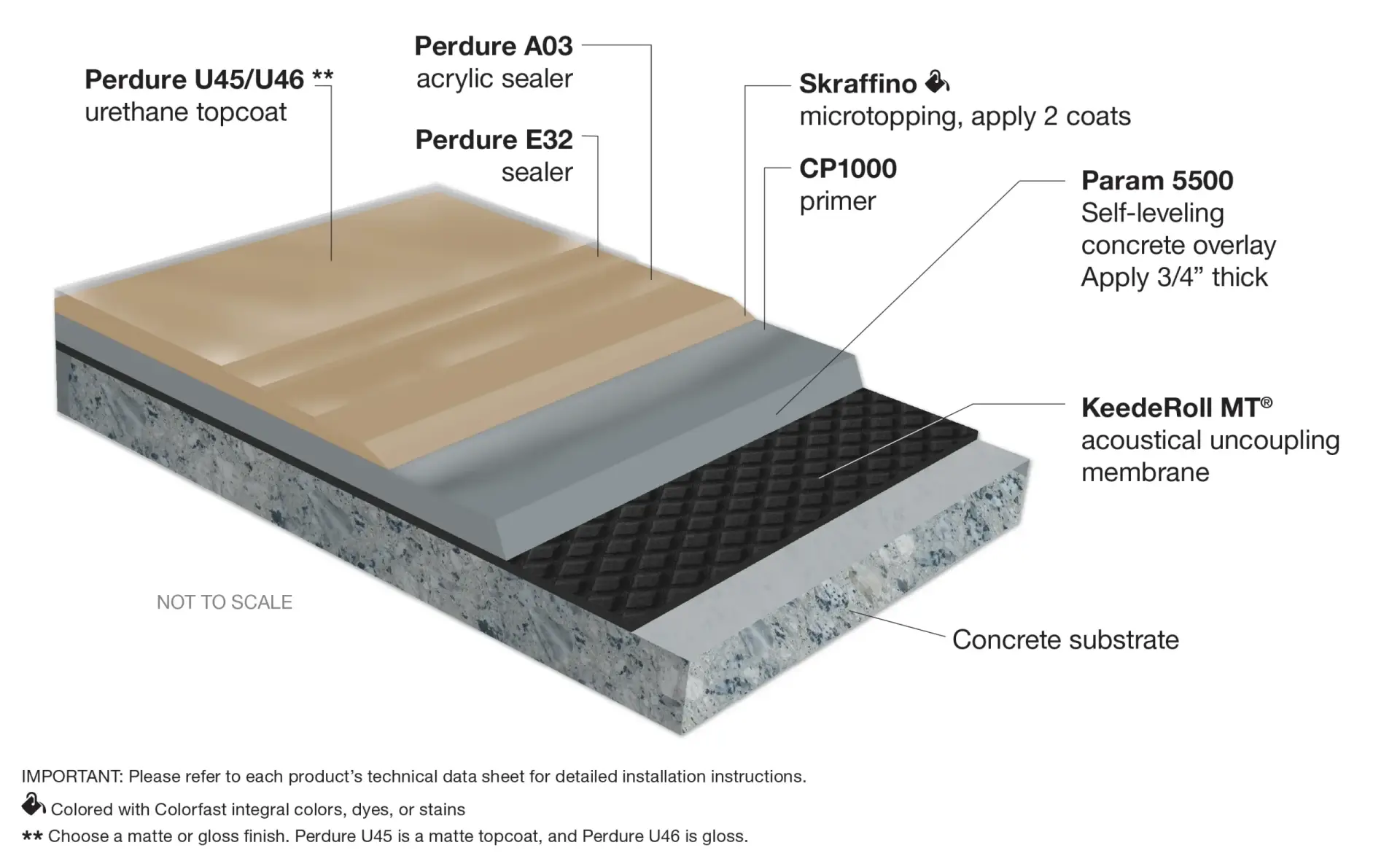
KeedeRoll® MT goes down first, directly over the concrete substrate. KeedeRoll® MT is an acoustical uncoupling membrane (MT stands for Muffling Technology), and it works by decoupling the finished floor from the slab below. When the two surfaces aren’t in direct contact, vibrations from footsteps can’t travel straight through the structure into the space below. On an 8″ concrete slab, it achieves an IIC rating of 54, which meets code on its own.
Param 5500 goes over the KeedeRoll® MT at 3/4″ thick. This self-leveling concrete overlay creates a flat, stable surface for everything above. The added mass also helps block sound.
CP1000 primer goes on next, preparing the Param 5500 surface to bond with the microtopping.
Skraffino microtopping goes on in two coats. This is the decorative layer, the part you see and walk on every day. Because it applies thin, it doesn’t raise your floor height the way tile or hardwood would. It can be colored with Colorfast integral colors, dyes, or stains, so you have complete control over the final look. The result is a seamless, continuous surface with no grout lines to trap dirt and no tile edges to chip or crack.
Perdure A03 acrylic sealer and Perdure E32 sealer follow the Skraffino, building the protective base before the topcoat.
Perdure U45 or U46 urethane topcoat closes the system. U45 is matte, U46 is gloss. Either way, you get a wear-resistant surface that holds up to daily use and cleans easily.
Where This Makes Sense for DFW Homeowners and Property Owners
This system works well for a wide range of projects across the Dallas-Fort Worth area:
- Upstairs living areas and hallways in two-story homes in Plano, McKinney, Allen, Frisco, Prosper, Southlake, Keller, Flower Mound, and Lewisville
- Condo and townhome renovations in Uptown Dallas, Victory Park, downtown Fort Worth, Las Colinas, Irving, Grapevine, and Carrollton
- New construction in master-planned communities throughout Collin, Denton, and Tarrant counties, including Celina, The Colony, and Coppell, where HOA noise standards apply
- Home theaters and media rooms, where acoustic control and a premium finish both matter
- Recording studios and music practice spaces in residential and commercial properties across North Texas
It also fits commercial projects throughout DFW, including offices, hotels, and healthcare facilities where sound control and a polished look go hand in hand.
What You End Up With
A finished Duraamen soundproof floor looks like polished concrete. No grout lines, no tile edges, no visible seams. The surface is easy to clean, holds up under daily foot traffic, and comes in matte or gloss depending on which topcoat you choose. The color runs consistently across the entire floor and is locked in at installation.
What you don’t end up with is the noise problem that hard floors are known for. The KeedeRoll® MT acoustical membrane handles that at the base of the system, before the finished surface ever comes into the picture.
If you’re a DFW homeowner, property owner, or contractor looking for a concrete floor that solves the sound problem and still looks the way you want it to, Duraamen’s team at their Lewisville location serves the full Dallas-Fort Worth area and can build the system around your project.
Duraamen Dallas-Fort Worth 985 E State Hwy 121, Suite 606 Lewisville, TX 75057 214.613.2494 Monday–Friday, 9am–5pm