


Introduction: The Brewery Flooring Battlefield
Breweries are uniquely punishing environments. Floors face a relentless, daily assault from thermal extremes, harsh chemical cleaning cycles, heavy traffic, and constant moisture. A standard industrial floor coating simply won’t survive here. The result of a poor flooring choice is predictable: premature failure, costly downtime, and potential contamination risks.
This is why urethane cement flooring has become the undisputed gold standard in modern brewery flooring design. It is not a cosmetic upgrade; it is a critical piece of operational infrastructure designed to withstand exactly what a brewery can dish out. This guide cuts through the noise to explain why it’s worth the investment, how it works, and where it makes undeniable financial sense for your business.
What Is Urethane Cement Flooring? (Your Concrete’s Armor)
Urethane cement flooring is a thick, durable, seamless system engineered for extreme industrial environments. It is a composite material combining:
- Urethane Polymers: Provide exceptional flexibility, chemical resistance, and thermal shock tolerance.
- Cementitious Fillers: Give the system compressive strength, density, and a familiar, durable base.
- Aggregates (like quartz): Impart superior abrasion resistance and texture for slip resistance.
Unlike a thin epoxy coating (which sits on top of the concrete like a layer of paint), urethane cement is a mortar system. It is trowel-applied at thicknesses ranging from 1/4″ to 3/8″ (6mm-10mm), forming a monolithic, fully bonded “armor plate” over your concrete slab. This bond and mass are key to its performance.
The Biggest Brewery Killer: Thermal Shock (And How Urethane Beats It)
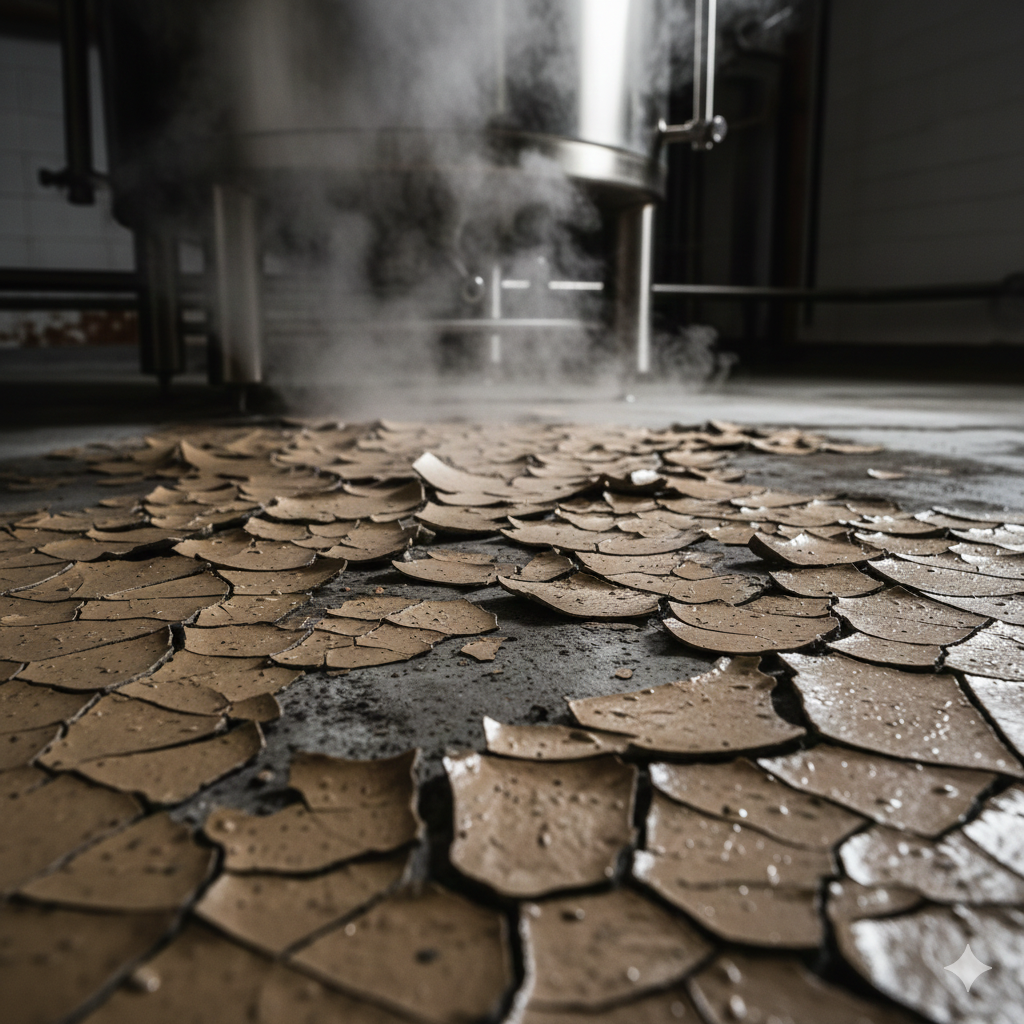
Thermal shock is the rapid and extreme change in temperature that causes materials to expand and contract at different rates. In a brewery, this happens when 180°F+ (82°C+) hot wort or boiling water is spilled or hosed onto a cold floor, or during hot CIP cycles.
- Why Epoxy Fails: Epoxy is rigid and brittle. When the underlying concrete expands rapidly from heat, the inflexible epoxy coating cannot move with it. This causes stress, leading to cracks, delamination (where the coating peels up from the slab), and ultimately, failure. Once cracked, chemicals and moisture penetrate, destroying the slab beneath.
- How Urethane Cement Succeeds: Urethane polymers have a much higher degree of flexibility and elongation. The system can absorb the movement of the concrete substrate without cracking. A quality urethane cement floor can handle continuous thermal cycling from below freezing in cold storage to over 200°F (93°C) in the brewhouse, making it ideal for the entire production loop.
Chemical Resistance & Surviving CIP Cycles
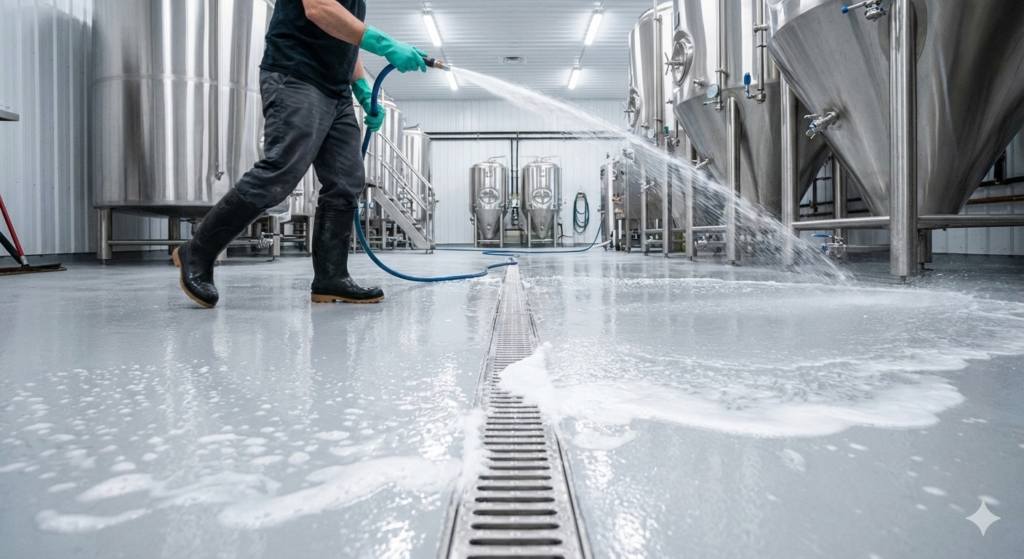
Brewery hygiene depends on aggressive Clean-in-Place (CIP) protocols. Floors are routinely exposed to:
- Hot Caustic Soda (pH 14+): For degreasing and organic removal.
- Acidic Solutions (Nitric, Phosphoric): For sanitization and descaling.
- Acidified Sanitizers & Star San: For final sanitation.
- Beer, Wort, and Sugars: Which are acidic and promote microbial growth.
Urethane cement provides a non-porous, chemically inert barrier. It resists the full spectrum of brewery chemicals, preventing them from attacking the concrete substrate. This stops the formation of “rat holes”, the pitting and erosion of concrete that creates harborage points for bacteria and becomes a maintenance nightmare. A seamless, chemical-resistant floor is your first line of defense in maintaining a sanitary environment.
Hygiene, Safety & HACCP Compliance

For food and beverage production, flooring is a critical control point.
- Seamless & Non-Porous: Unlike tiled floors with grout lines, urethane cement is installed without seams. This eliminates the primary location where bacteria, mold, and yeast can hide and thrive. It allows for complete runoff and easy cleaning.
- Inherently Anti-Microbial: The dense, non-porous surface doesn’t allow microbial penetration. When paired with proper slope to drains, it supports a hygienic environment that aligns with HACCP, FDA, and USDA principles for food-contact zones.
- Wet Slip Resistance: Urethane systems can be finished with broadcast aggregates to create a highly textured, slip-resistant surface even when wet, a critical safety feature in perpetually damp areas like the cellar and packaging hall.
Cost of Urethane Cement Flooring vs. Epoxy
Let’s be transparent: the initial investment is higher. You are paying for advanced materials and specialized installation expertise.
- Epoxy Coating: $3 – $6 per sq. ft. installed. This is a coating. It is suitable for light industrial use but is a high-risk choice for main production areas in a brewery.
- Urethane Cement Flooring: $8 – $15+ per sq. ft. installed. This is a system. The price varies based on system thickness, aggregate type, floor prep complexity, and project size.
The key question is not “What does it cost?” but “What does a failure cost?” The higher upfront cost of urethane is a direct investment in eliminating future failure costs.
Lifespan & ROI: The Real Justification for Breweries
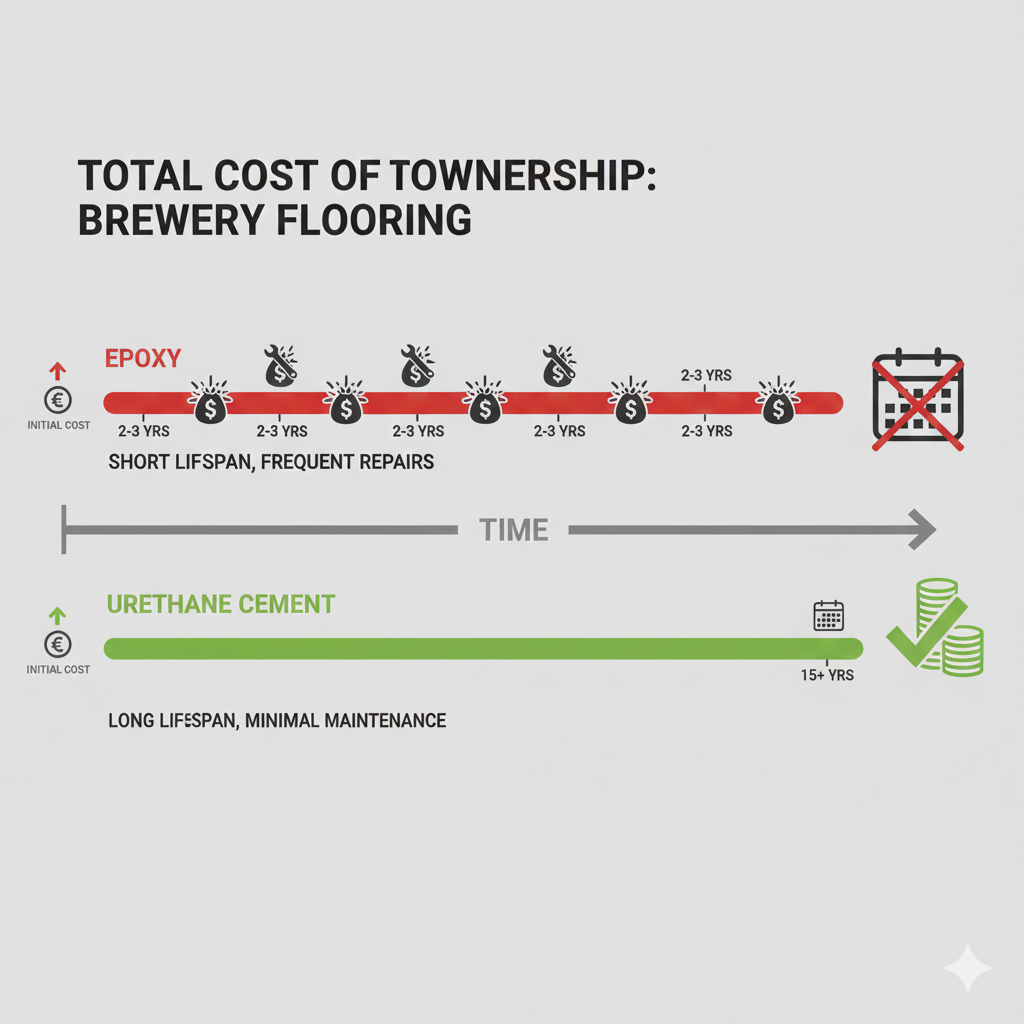
This is where the math becomes compelling for any operations manager or owner.
- Typical Epoxy Lifespan in a Brewery: 1-3 years in high-traffic, wet processing areas before significant repair or replacement is needed.
- Typical Urethane Cement Lifespan: 15-20+ years with proper installation and maintenance.
The ROI Calculation:
Consider the true cost of a flooring failure:
- Production Downtime: Shutting down a cellar or brewhouse for repairs can cost thousands per day in lost production.
- Emergency Repair Costs: Premium rates for rushed work and materials.
- Contamination Risk: A failed floor jeopardizes product safety and quality.
- Repeat Investment: Replacing epoxy every few years means paying for installation multiple times.
While urethane costs 2-3x more initially, its 5-7x longer lifespan means a lower total cost of ownership. You are buying operational continuity and eliminating a recurring problem.
Where Urethane Flooring Is Essential (And Where It’s Not)
Essential – Install Urethane Cement Here:
- Brewhouse: Thermal shock from spills, chemical exposure.
- Fermentation & Bright Beer Cellars: Constant moisture, chemical washdowns, low temperatures.
- Packaging Halls: Wet environment, high wheeled traffic, chemical sanitation.
- Washdown Areas & Drainage Channels: Maximum chemical and thermal exposure.
Optional – Other Solutions May Suffice:
- Dry Storage Areas: Epoxy or polished concrete may be adequate.
- Taprooms & Public Spaces: Aesthetic polymer floors or epoxy can work, though urethane provides unmatched durability.
- Offices & Hallways: Standard commercial flooring is appropriate.
Final Verdict: Is Urethane Flooring Worth It for Breweries?
Yes, unequivocally, for your core production areas.
If you are building a new brewery or renovating an existing one, specifying urethane cement flooring for the brewhouse, cellar, and packaging areas is a non-negotiable best practice. It is the standard for a reason.
- For the Brewery Owner: It is a capital investment that protects your larger investment in tanks and equipment by ensuring a stable, hygienic, and durable foundation. It future-proofs your facility.
- For the Operations Manager: It is a tool for achieving consistent sanitation, reducing safety incidents, and avoiding catastrophic downtime. It makes daily operations smoother.
- For the Contractor: It is the correct, professional specification that will result in a satisfied client and no callbacks for premature failure.
The philosophy is simple: Do it once, do it right. The cost of the right floor is forgotten after the project is done. The cost of the wrong floor is remembered every time it cracks, leaks, or shuts down your production line. For the harsh, demanding world of brewing, urethane cement isn’t just another option, it’s the solution.