


Introduction: The Foundation of Every Great Floor
Concrete grinding is the mechanical process of removing material from a concrete surface using industrial-grade equipment embedded with diamond abrasives. It’s not a cosmetic treatment, it’s foundational work. Whether you’re preparing for an epoxy coating, restoring an old slab, or achieving a polished concrete finish, grinding is the critical first step that determines the longevity and performance of the final product.
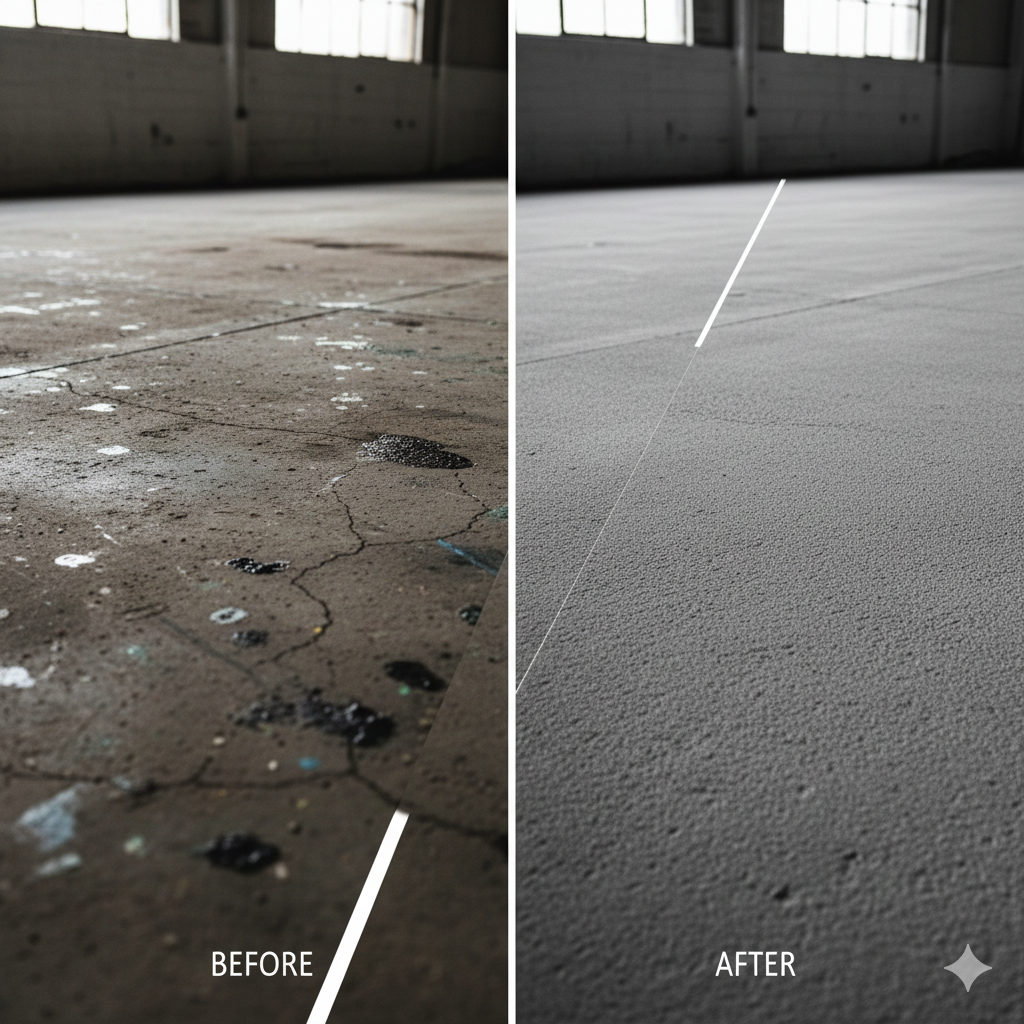
Think of it like painting a wall: you wouldn’t apply premium paint over peeling old layers without sanding. Grinding is that sanding, but for concrete. It’s a noisy, dusty, and physically demanding process that requires specific equipment and knowledge. Getting it wrong means adhesive failure, coating delamination, or an uneven finish. Getting it right means a floor that lasts decades.
What is Concrete Grinding?
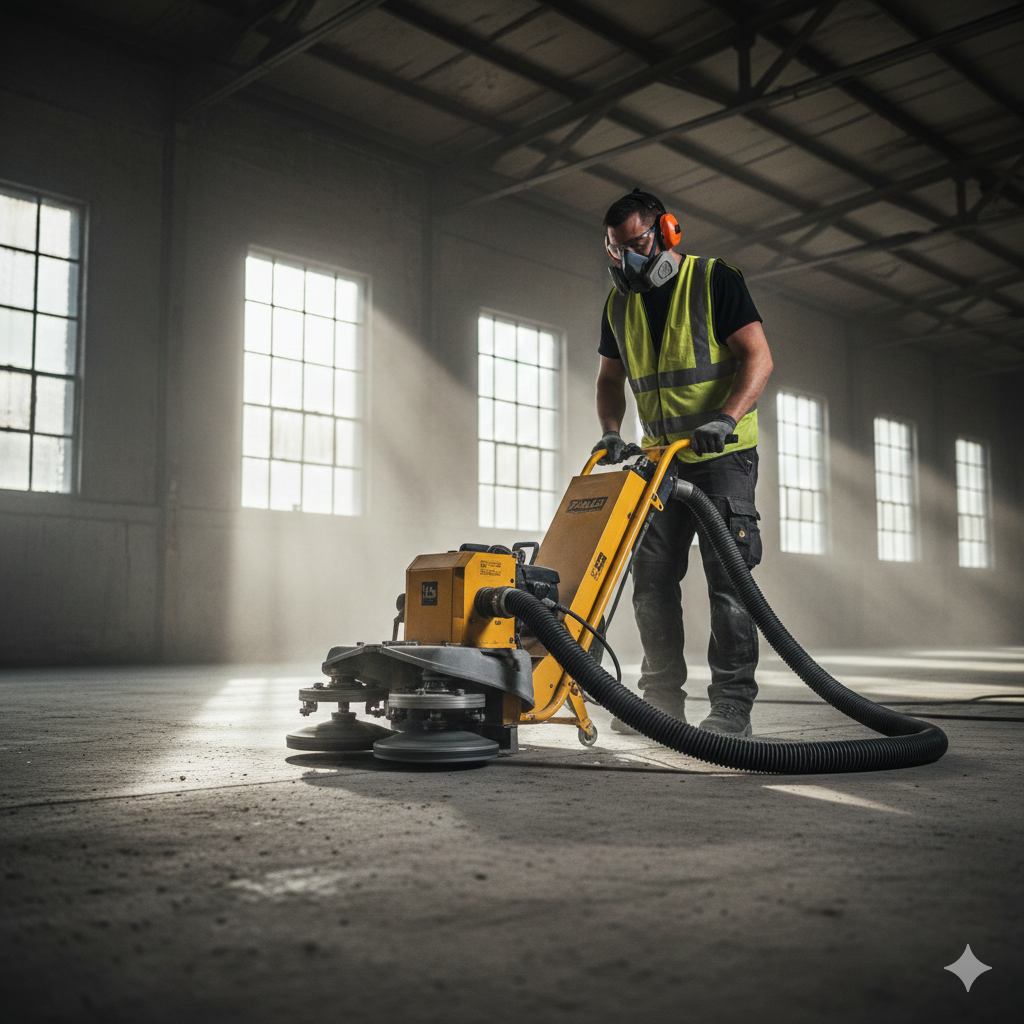
At its core, concrete grinding is a controlled abrasion process. An industrial grinder, powered by electricity, propane, or diesel, rotates diamond-impregnated tooling (called segments or pads) across the concrete surface. These diamonds microscopically fracture and cut away the concrete, leveling it and creating a specific surface profile.
The Two Phases of Grinding:
- Coarse Grinding: Uses diamond segments with large, aggressive grit (like 16-grit or 30-grit metal bonds) to remove high spots, old coatings, or significant imperfections. This is the “heavy lifting” stage.
- Fine Grinding & Polishing: Uses progressively finer diamond grits (from 80-grit up to 3000-grit or higher) to refine the surface, eliminate coarse scratches, and eventually develop a shine.
The difference between a rough, bare concrete slab and a perfectly smooth, polished floor is simply the progression of diamond grits used during grinding.
Why Concrete Grinding is Done: The 3 Core Purposes
1. Cleaning & Restoration
Before any new coating can be applied, the existing surface must be absolutely clean and sound. Grinding is the most effective method to remove:
- Contaminants: Paint, glue, mastic, thinset, oils, and sealers that prevent proper adhesion.
- Surface Damage: Light scaling, spalling, or weathering to reveal sound concrete underneath.
- Imperfections: “Bird baths” (low spots) and high spots to create a level plane.
Real-World Case: A warehouse with old tile adhesive (cutback) must have every trace of the black, tarry residue removed before epoxy can be applied. Grinding is the only method that completely removes it and profiles the concrete simultaneously.
2. Surface Profiling (The Key to Coating Adhesion)
This is the single most important reason for grinding before applying a coating like epoxy or urethane. Adhesion is mechanical, not chemical. A coating needs tiny peaks and valleys a “profile” to lock into.
Understanding the CSP (Concrete Surface Profile) Scale:
- CSP-1 (Very Light Profile): A barely perceptible texture. Often achieved by light shot blasting or acid etching (which we don’t recommend). Generally insufficient for most coatings.
- CSP-2 (Light Profile): A fine, satin texture. Suitable for thin, low-viscosity coatings. Achieved with fine-grit diamonds (80-100 grit).
- CSP-3 (Medium Profile): The industry standard for most epoxy and urethane systems. It feels like 60-grit sandpaper. This profile, achieved with 30-40 grit metal diamonds, provides the optimal anchor pattern for a tenacious mechanical bond.
- CSP-4-10 (Heavy to Very Heavy): For thick, slurry-type toppings or exceptionally demanding environments.
Why Epoxy Fails Without Proper Profile: Epoxy applied to a smooth, unprofiled slab (like a garage floor sealed by the builder) will initially stick but eventually delaminate under thermal stress or impact. It has nothing to grip.
3. Concrete Polishing
Polished concrete isn’t a coating; it’s the concrete itself, ground and refined to a specified level of shine and density. The process is a sequential grinding progression:
- Coarse Grinding (Metal Bonds): 30/40-grit to remove the surface and level the slab.
- Fine Grinding (Metal/Resin Bonds): 80-grit through 200-grit to remove the deep scratches from the previous step.
- Honing (Resin Bonds): 400-grit through 800-grit to begin developing a satin sheen.
- Polishing (Resin Bonds): 1500-grit through 3000-grit (or higher) to achieve a glossy, reflective surface.
- Densification & Sealing: A chemical hardener is applied, then a guard or sealer to protect the surface.
The “shine” comes from refining the concrete’s surface to a mirror-like smoothness, not from a topical coating.
Grinding Equipment Explained: Choosing the Right Tool
| Equipment Type | How It Works | Best For | Limitations |
| Rotary Grinder (Single-Head/Direct Drive) | A single motor spins one large grinding head (often 20-32 inches) in a circular pattern. | Aggressive removal, stripping coatings, leveling severe imperfections, outdoor work. | Can leave noticeable circular “swirl” marks, requires more skill to keep level, not ideal for fine polishing. |
| Planetary Grinder (Multi-Head) | A central motor drives 2-4 smaller grinding heads that rotate on their own axes and orbit around a central axis. | Final surface prep, polishing, and achieving a perfectly flat finish. The orbital action eliminates swirl marks and creates a more uniform scratch pattern. | Less aggressive removal rate than a rotary, higher initial cost. |
Rule of Thumb: For coating prep (CSP-3), a rotary grinder with coarse diamonds is the workhorse. For a flawless polished concrete finish, a planetary grinder is non-negotiable.
Diamond Tooling Breakdown: The Cutting Edge
The diamonds are what do the work. Choosing the right one is critical.
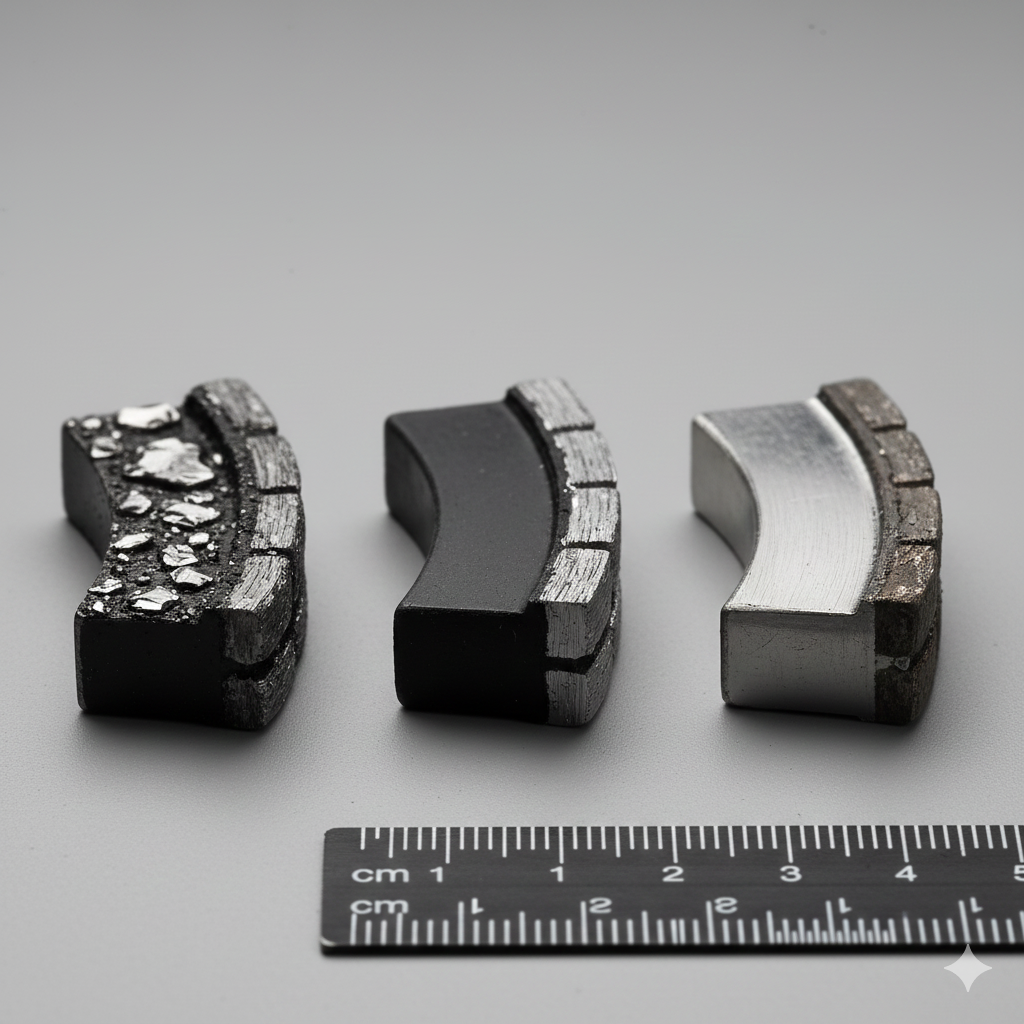
- Metal Bond Diamonds: The diamond segments are held in a metal matrix (usually steel or cobalt). This bond wears away slowly, constantly exposing fresh, sharp diamonds. Use: Coarse grinding (30-80 grit) for removal, leveling, and establishing initial profile. Aggressive and long-lasting.
- Resin Bond Diamonds: The diamonds are held in a plastic or resin matrix. This softer bond wears faster, exposing diamonds more quickly for finer cutting. Use: Fine grinding (100+ grit) and polishing. Creates a smoother scratch pattern essential for achieving a high-gloss finish.
Matching Diamonds to Concrete: The hardness of your concrete (measured by Mohs scale or simply by its age/aggregate) matters. Soft concrete requires a harder bond matrix to prevent the diamonds from being ripped out. Hard concrete requires a softer bond to allow for proper diamond exposure. An experienced contractor will test the slab first.
Safety & Silica Dust: The Non-Negotiable Section
Respirable Crystalline Silica (RCS) is the dust generated when cutting, grinding, or drilling concrete and masonry. These particles are 100 times smaller than a grain of sand and are a known carcinogen.
- Health Risks: Inhaling RCS causes silicosis (an incurable, scarring lung disease), lung cancer, COPD, and kidney disease. Effects are cumulative and irreversible.
- The Mandatory Solution: HEPA Vacuum Shrouds. A grinder must be equipped with a shroud that contains the dust and is connected to a HEPA (High-Efficiency Particulate Air) vacuum that captures at least 99.97% of particles at 0.3 microns. Shop vacuums are NOT sufficient and are dangerously inadequate.
- Red Flags When Hiring a Contractor:
- They propose “dustless grinding” using only a water hose (which creates a toxic slurry).
- They use a standard shop vac attached to their grinder.
- Workers are not wearing fitted NIOSH-approved N95 or P100 respirators.
- There is no site containment (plastic sheeting, zip walls) for indoor work.
This isn’t just a best practice; it’s an OSHA-regulated standard (29 CFR 1926.1153). Any contractor who downplays silica dust is not a professional you want in your home or facility.
Wet Grinding vs. Dry Grinding
| Factor | Wet Grinding | Dry Grinding (with HEPA) |
| Dust Control | Excellent – dust is suppressed as slurry. | Excellent – dust is captured at source by HEPA vacuum. |
| Visibility | Poor – slurry obscures the work surface. | Excellent – operator sees the concrete clearly. |
| Cleanup | Heavy – involves managing wet, heavy silica slurry that must be disposed of as hazardous waste. | Clean – dust is contained in vacuum filters. |
| Indoor Use | Problematic – slurry can seep into cracks, cause mess, and requires extensive cleanup. | Standard – the clean, controlled method for indoor work. |
| Outdoor Use | Often acceptable, but slurry runoff is an environmental concern. | Preferred if dust migration can be controlled. |
| Equipment Wear | Reduced – water cools diamonds and machine. | Higher – requires proper dust extraction to avoid overheating. |
Modern Standard: For almost all interior residential and commercial work, dry grinding with integrated HEPA dust collection is the professional, safe, and efficient method.
Common Mistakes to Avoid
- Skipping Grinding Before Epoxy: Acid etching or just cleaning is not a substitute. It creates an inconsistent, weak profile and does not remove contaminants.
- Using Acid Etching: An outdated, dangerous, and unreliable method. Results depend on concrete chemistry, leaves residual salts that harm adhesion, and poses severe chemical hazards.
- DIY Without Proper Dust Control: Renting a grinder without a HEPA system exposes you, your family, and your property to toxic silica dust. The risk is not worth the savings.
- Choosing the Wrong Tooling: Using fine-grit pads to try to remove thick paint will glaze the pads and accomplish nothing. You must start with the correct aggressive tooling for the task.
When to Hire a Professional
Hire a professional concrete grinding contractor when:
- The area is larger than a one-car garage (approx. 200 sq. ft.). The equipment rental, labor, and learning curve make DIY impractical.
- You are preparing for a coating system. The margin for error is zero; improper prep guarantees coating failure.
- The slab has significant imperfections, coatings, or requires leveling. Professional equipment is far more powerful and efficient.
- Dust control is a priority. A pro will have industrial HEPA equipment you cannot rent.
- You desire a polished concrete finish. The skill, sequential tooling, and equipment required are highly specialized.
DIY might be feasible for: A very small area (like a patio corner), using a handheld angle grinder with a diamond cup wheel, for a single specific task like removing a paint spill—with full PPE and dust control.
Conclusion: Durability Starts Below the Surface
Concrete grinding is the unsung hero of the flooring world. It’s the demanding, gritty work that happens before the attractive coating or glossy finish is applied. Its importance cannot be overstated: the performance and lifespan of your floor are directly determined by the quality of the surface preparation.
Investing in proper mechanical grinding using the right equipment, tooling, and dust control isn’t an extra cost; it’s the fundamental step that ensures your investment in epoxy, polish, or any other treatment pays off for decades. Remember: you can put a premium coating on a poorly prepared floor and it will fail. You can put a basic coating on a perfectly prepared floor and it will perform exceptionally. The preparation is everything.
The Takeaway: When planning your next concrete floor project, allocate your budget and focus first on the grinding and surface preparation. It’s the foundation upon which everything else is built.